97.2%
Citation rate
Locked 120-case benchmark

The self-hosted support intelligence engine for engineering-led manufacturers — grounded in your products, running on infrastructure you control, with every answer traceable to source.
For an engineering-led manufacturer, customer support bleeds money in four directions at once, and none of it shows on a single P&L line.
£40k–£100k of senior engineering time given away every year — untracked, unbilled, invisible.
Your best people answer tickets instead of building product — and the knowledge walks out the day they leave.
The moment support data hits a cloud AI platform, you may already be in breach of an NDA or export obligation.
The same part fails across eight systems over six months — and nobody connects it until it's a warranty crisis.
Cortex captures every case, resolves the routine work automatically, enforces your commercial policy, and turns recurring failures into product intelligence — learning a little more about your equipment with every case it touches. Self-hosted by default. Grounded in your data. Yours forever.
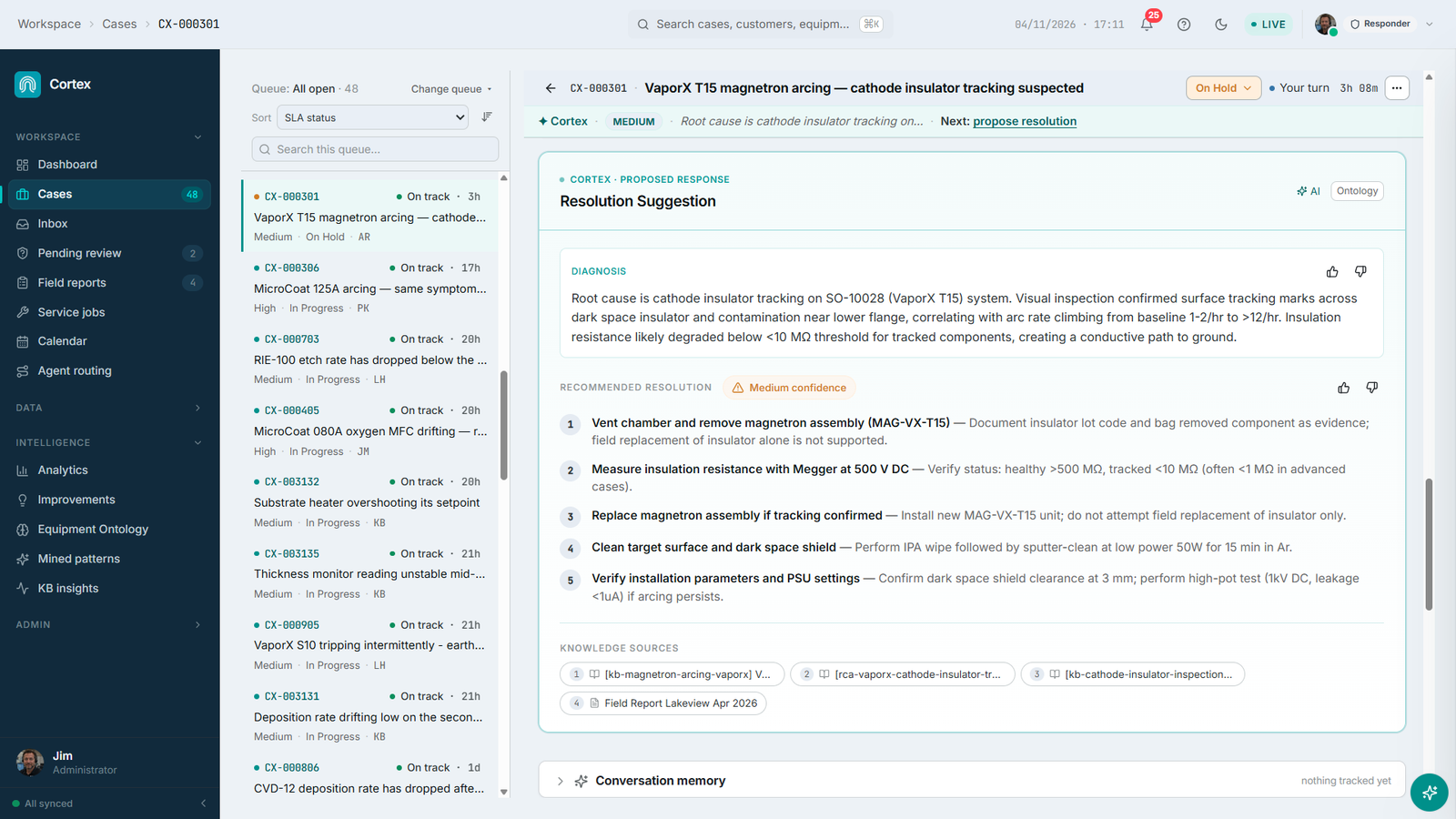
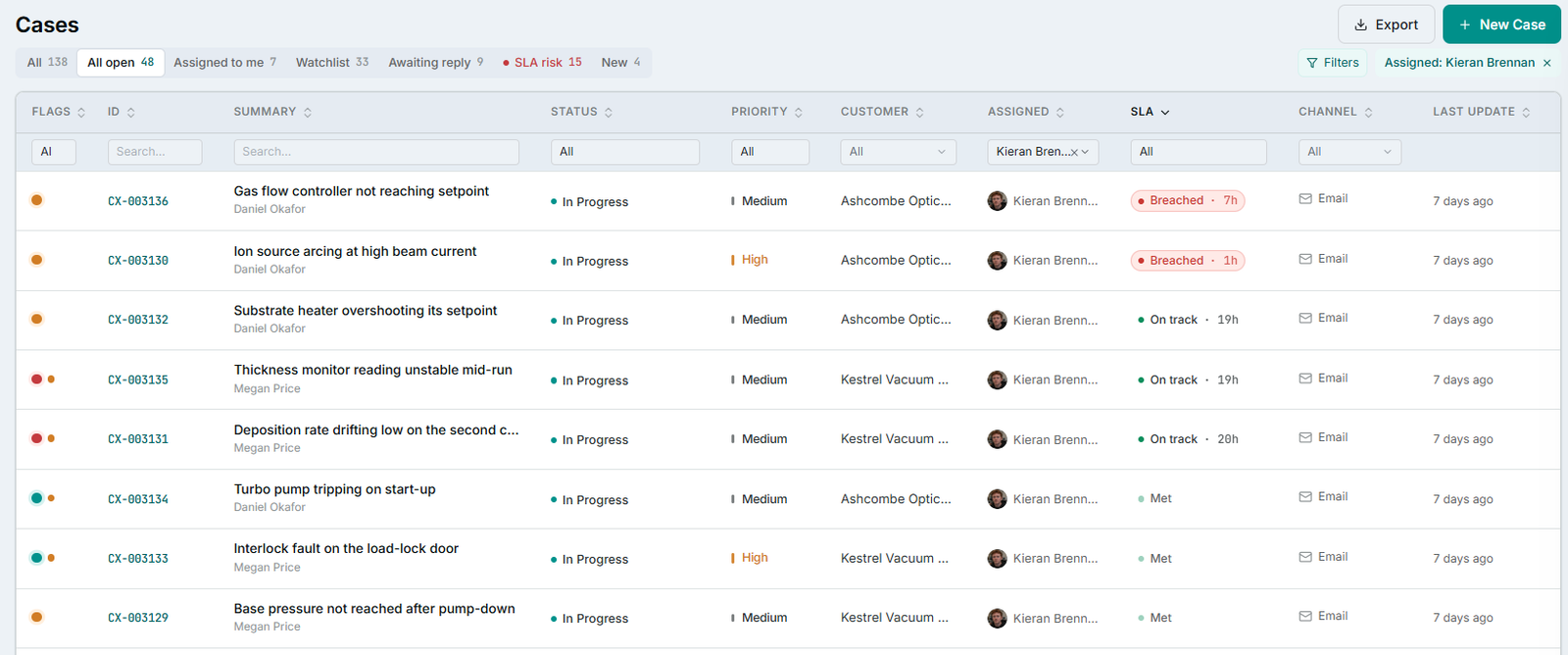
Cases arrive from any channel into one record, then are scored on contract, severity, warranty and repeat-failure signals and assigned automatically.
Cortex finds how similar cases were resolved before, proposes a grounded resolution, enforces commercial policy, drafts the reply, and raises a quote when free support is exceeded — for your engineer to review and approve.
Recurring failures become R&D intelligence; every closed case feeds the knowledge base, so accuracy compounds with every ticket.
A 90-second walkthrough of the case lifecycle, the conversion email, and the learning loop.
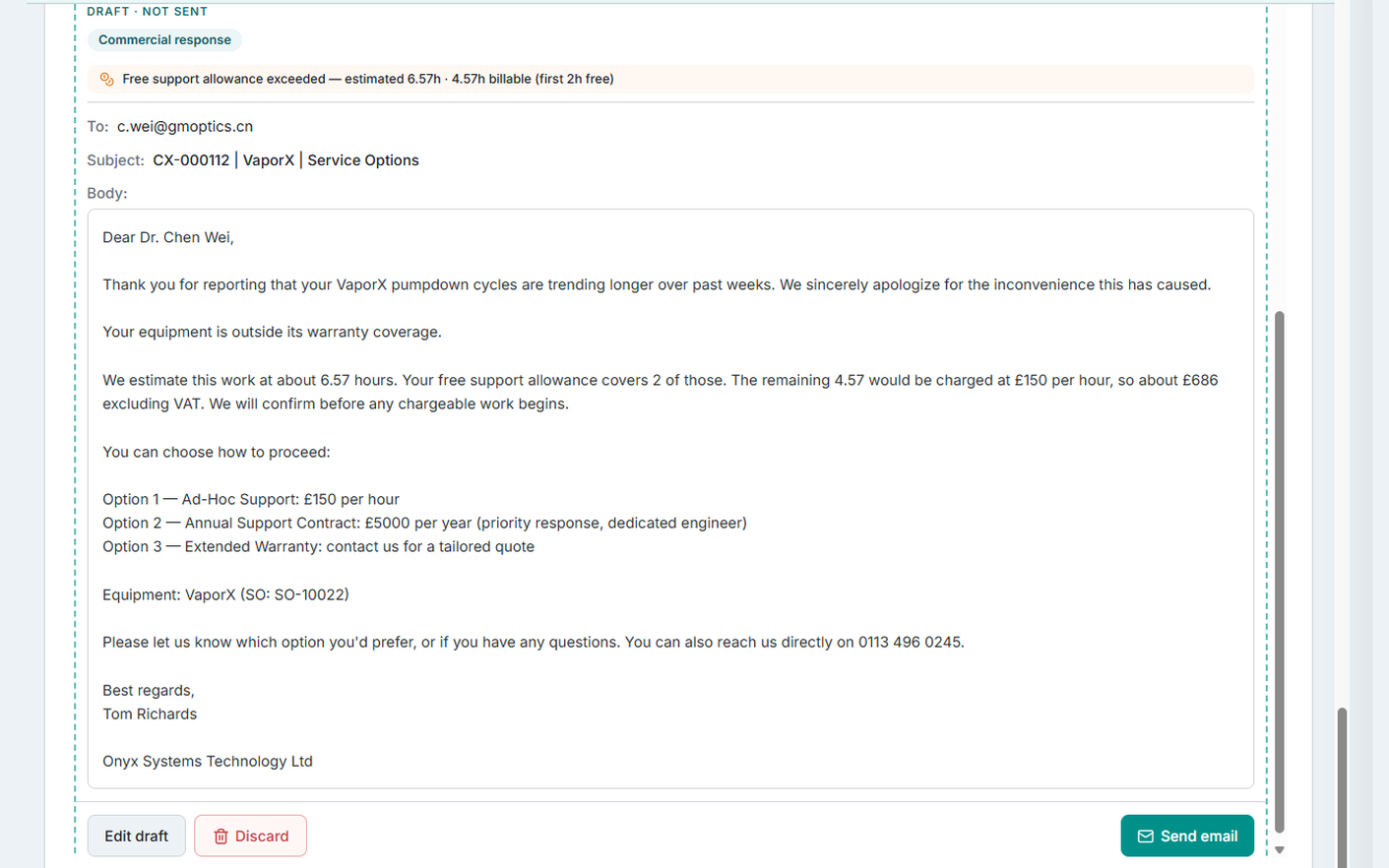
The commercial policy engine tracks support time against each customer’s free-hours allowance, contract tier and warranty, detects the moment a case becomes billable, and drafts a three-option offer with the price worked out — for your engineer to review and send. Support stops leaking money and starts generating it.
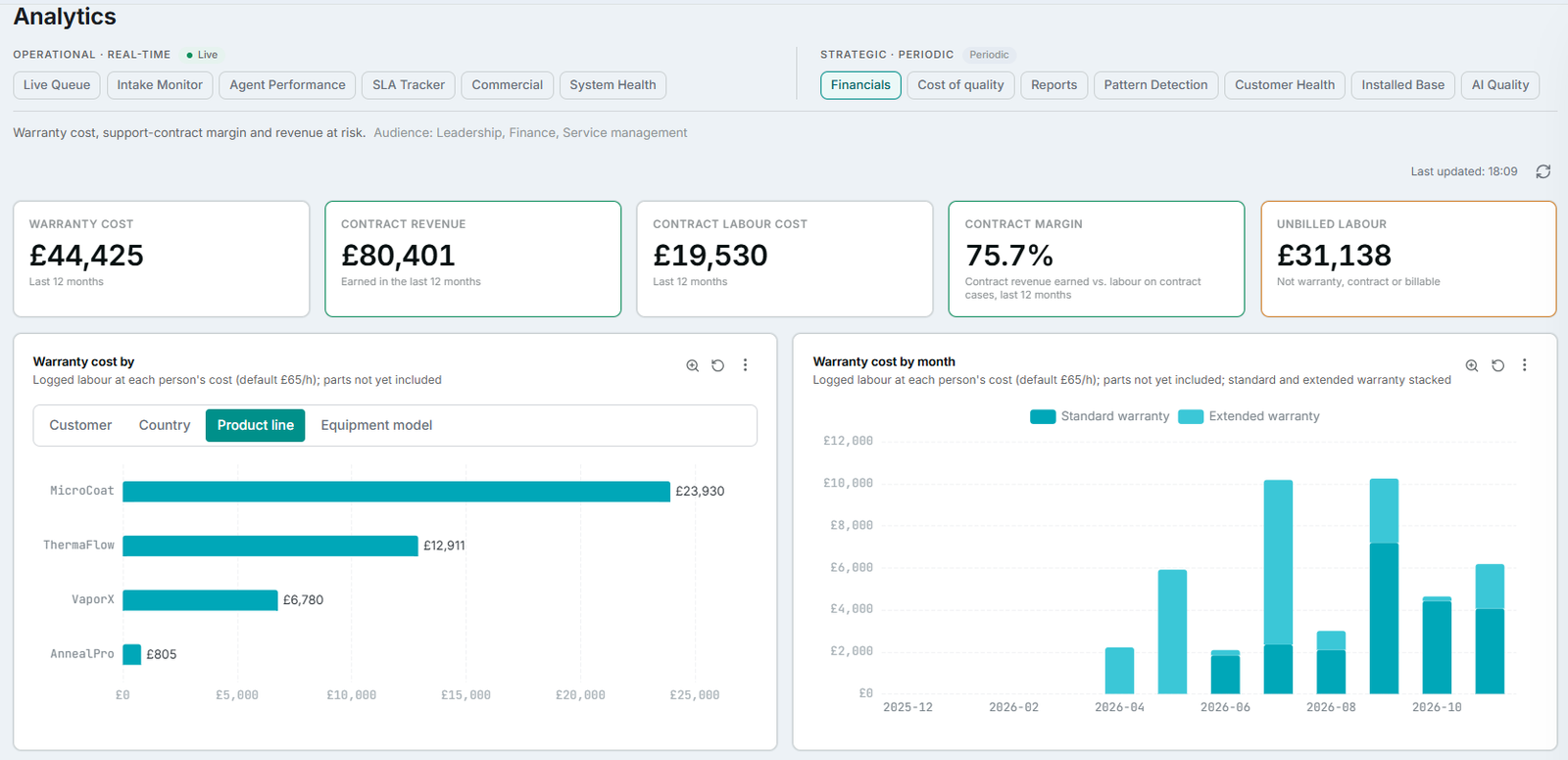
Underneath: rate cards and quotes, with the allowance set per year. The Financials tab shows earned contract revenue and labour cost per role and team, alongside the cost of quality.
Recurring failures are clustered across unit, part and component, then raised as structured Product Improvement Recommendations for engineering — with the at-risk installed-base list attached. Reactive support becomes proactive engineering.

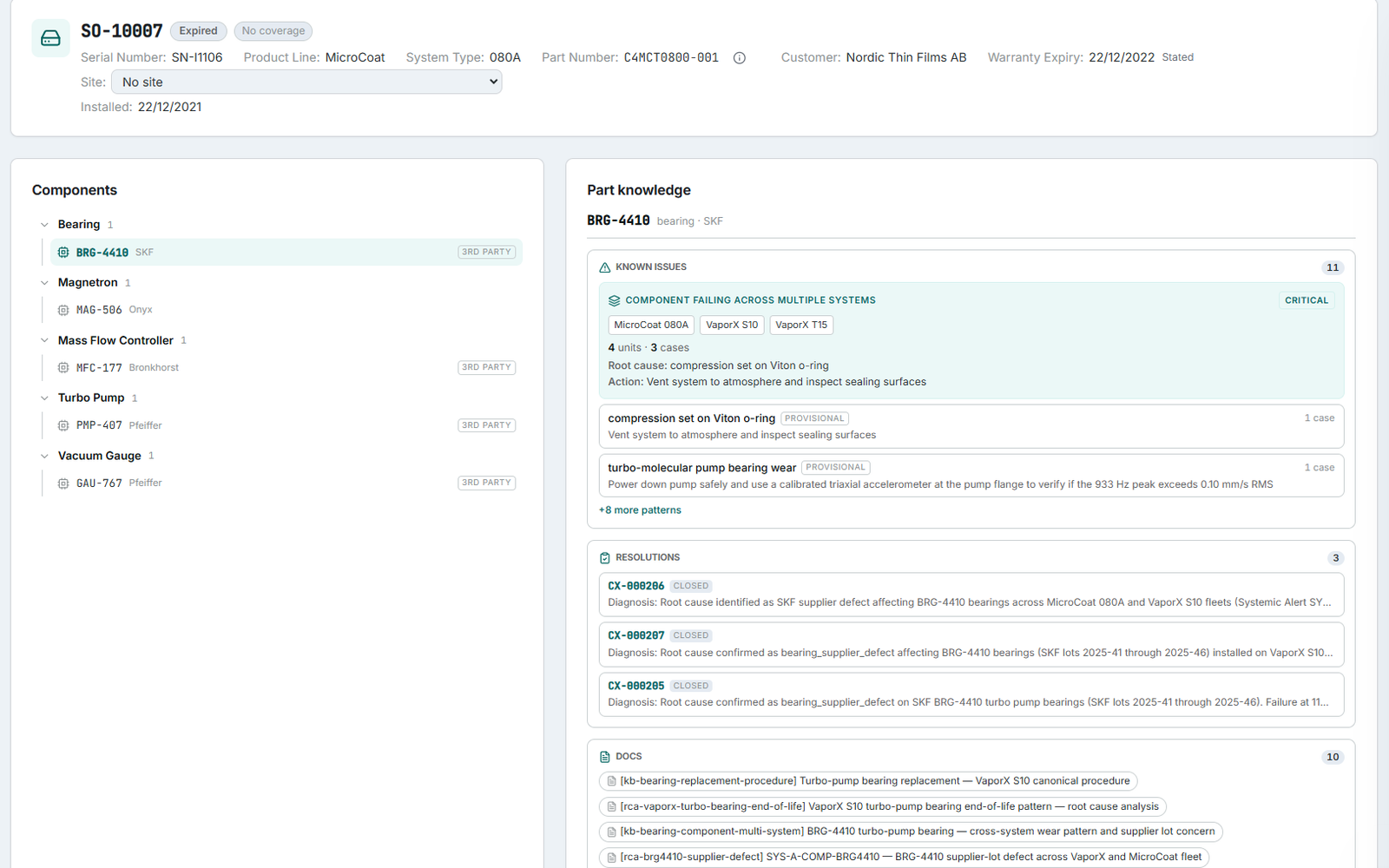
Knowledge is indexed by your bill of materials, not flat document storage. A case about one product pulls the right answer at product, sub-assembly and component level — specific to the exact configuration in front of the customer.
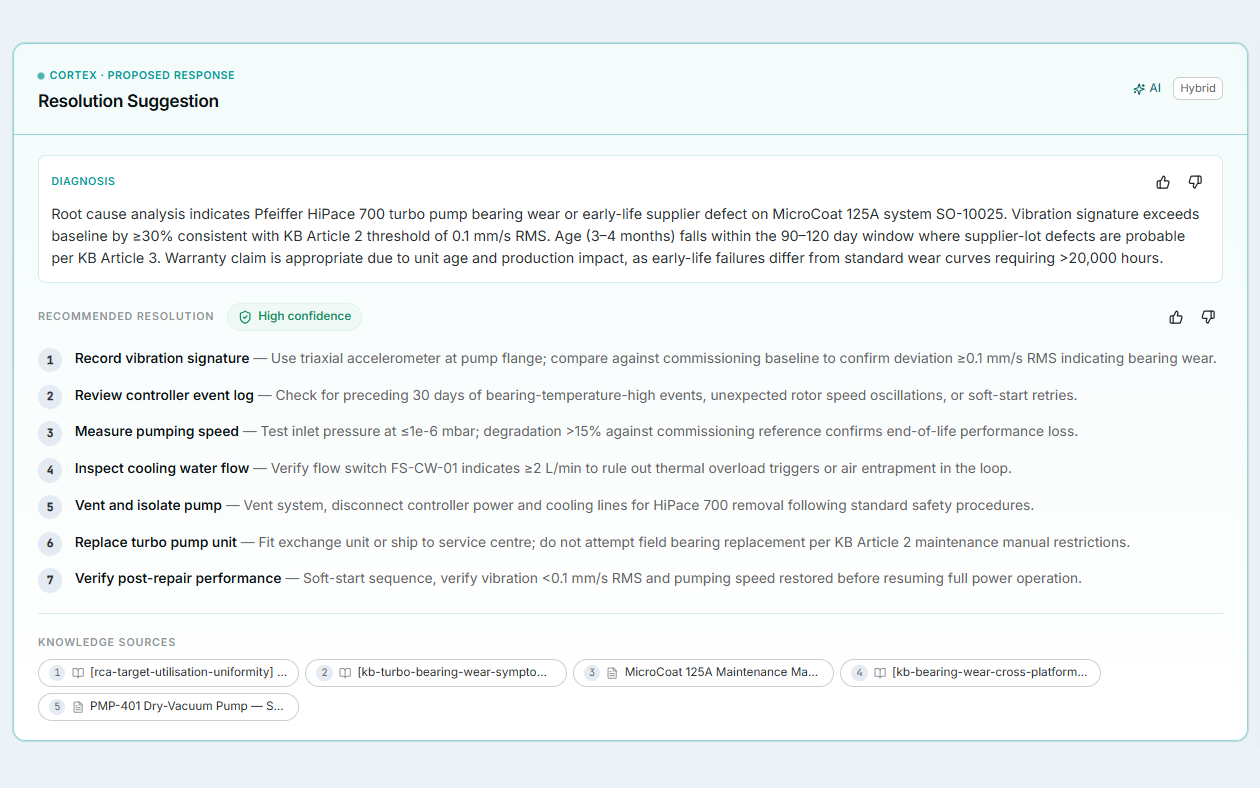
Every recommendation cites its source; if it can't, it flags inference rather than asserting fact. Every parameter is yours to set — and the AI model is swappable, so there's no lock-in at the AI layer.
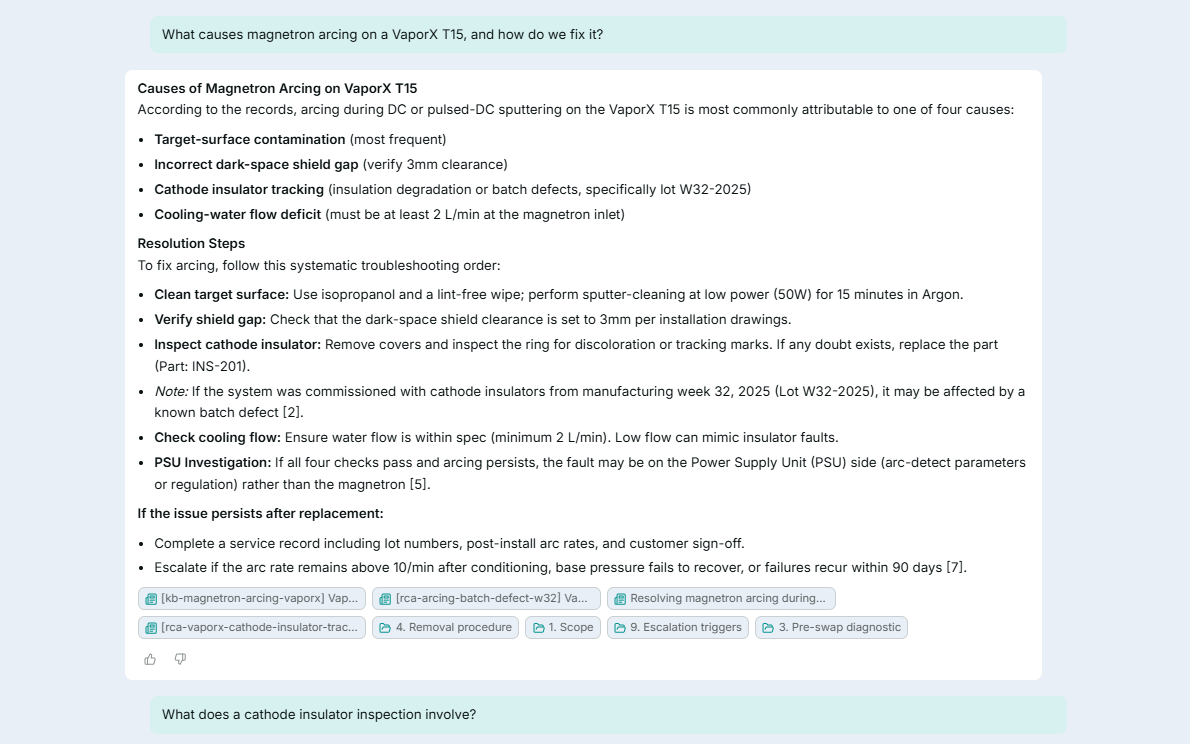
A conversational assistant over your whole operation. Ask how to fix a fault and it answers from your manuals and past cases, with every source linked. Ask how to do something in Cortex and it walks you through it — that's your onboarding, no manual required. Ask who owns a customer's open cases, or this month's satisfaction score, and it answers from your live data, showing each person only what they're allowed to see. Sharp, permission-aware, and with a dry sense of humour.
It now draws on your own library of policies and procedures, keeps your chat history, takes dictation into any long field, and transcribes long voice memos.
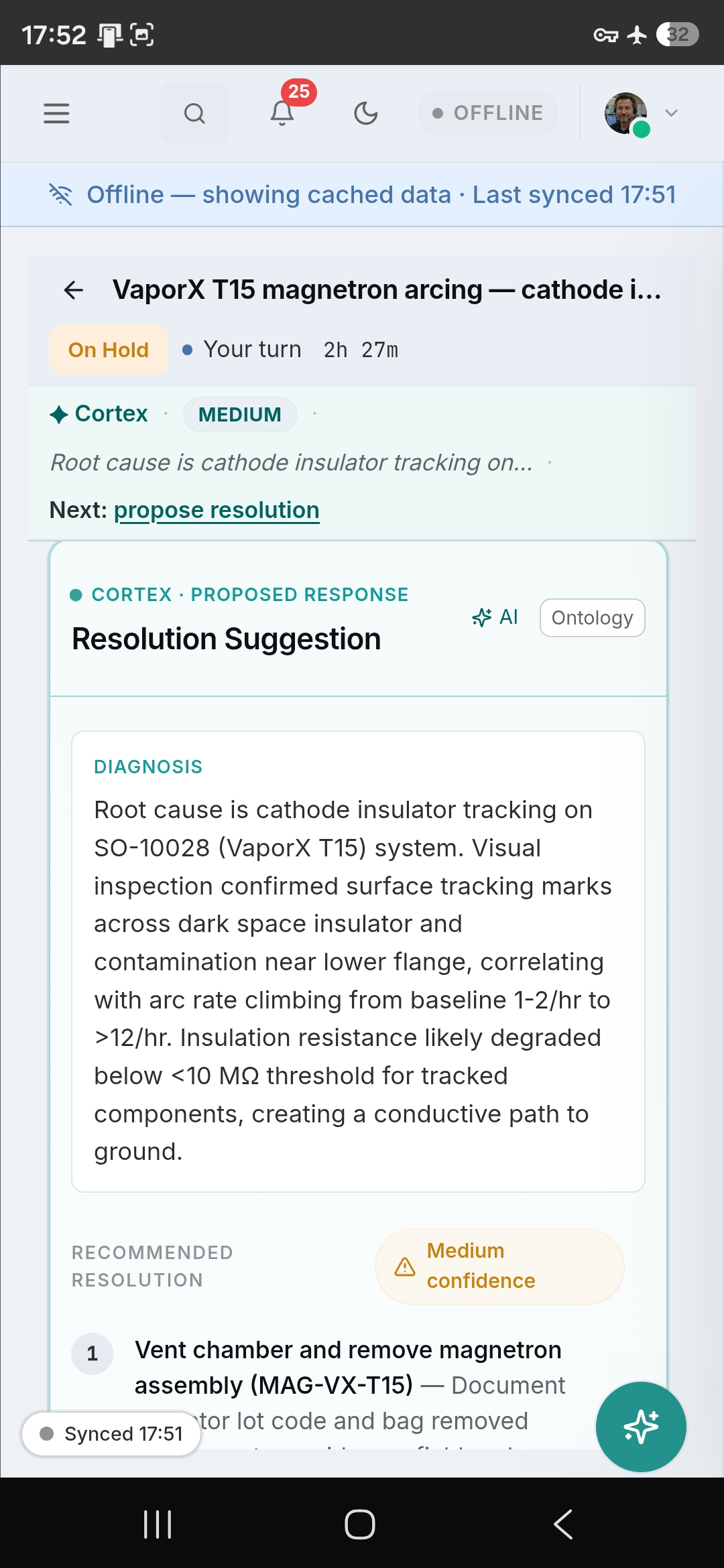
A native mobile app puts the whole operation in your engineer's pocket: update a case from a plant floor, capture a voice field report that transcribes itself, and read your cases even with no signal at all. On your own infrastructure, over a secure tunnel — because the work doesn't always happen at a desk.
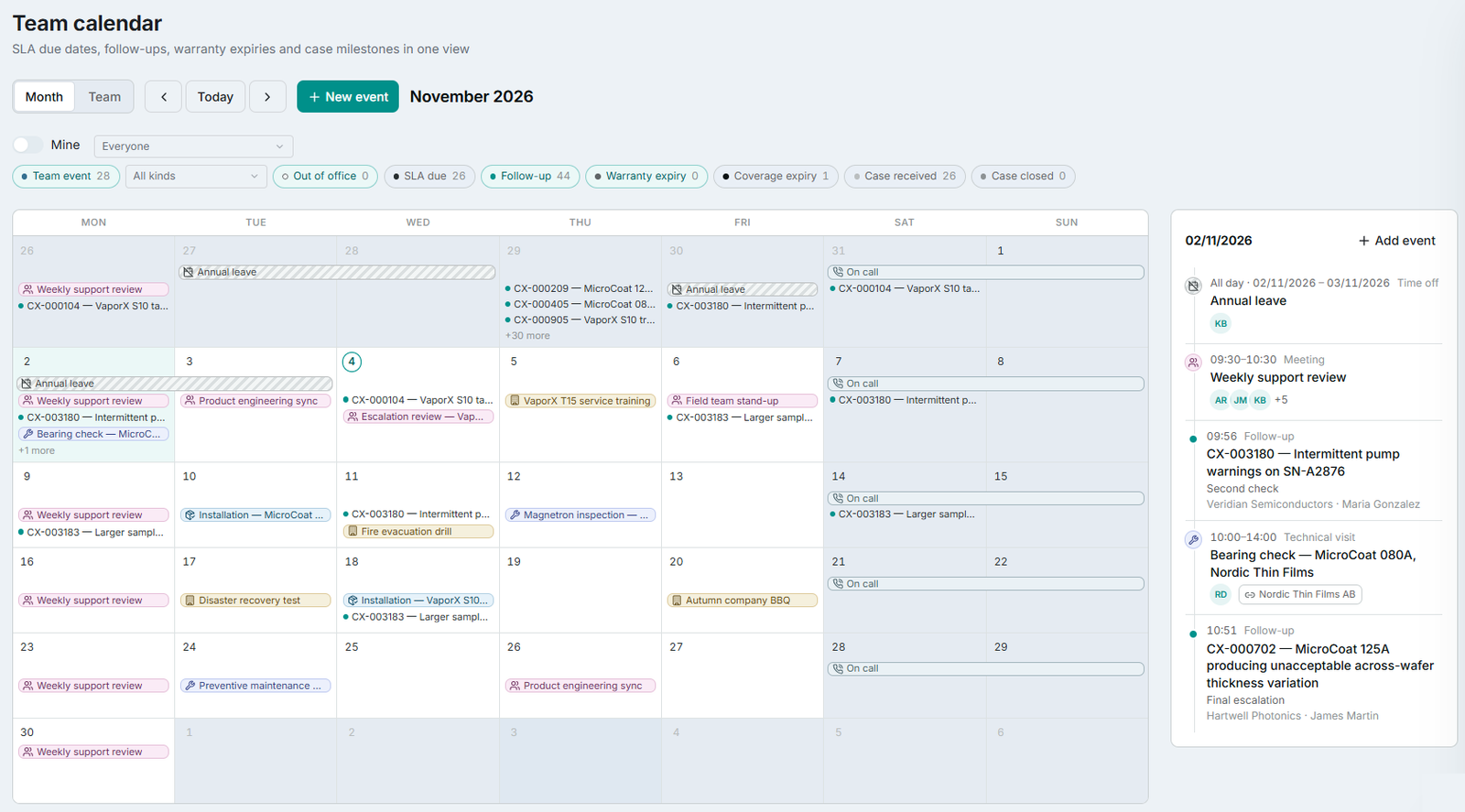
Case follow-ups and SLA due dates sit next to site visits, installations, on-call rotas and annual leave — so you see the work and who is free to do it in one view. Book leave with a named cover and new cases skip whoever is away. Open any day for the detail: which follow-up is due, at what stage, for which customer.
Warranty cost by product line and by month, support-contract revenue and margin, and the labour nobody billed — worked out from the time your engineers log, at each person’s cost. It is one of 13 dashboards, and every chart exports to CSV or Excel.
Every case carries a live first-response clock, counted in your working hours — closed days and bank holidays are skipped, and round-the-clock contract tiers run 24/7. The first reply settles the case as Met or Missed for good, so your compliance figures can’t be rewritten later.
No rip-and-replace. Cortex pulls your customers and installed base from the systems you already run: Salesforce, HubSpot, Zoho or Microsoft Dynamics for CRM; SAP, SAP Business One (file import), Priority, 123Insight or Zoho Books for ERP, or a plain Excel sheet if that is where your installed base lives. Tickets come in from Jira, Zendesk or Freshdesk, or straight from your Microsoft 365 support mailbox; documents from SharePoint or a network file share. Sign-on rides your own identity provider, and a Zoho CRM case link puts every Cortex case on the customer’s account. It reads from your systems of record, and writes only where you switch it on — which is exactly what your security team wants to hear.
Hover or tap a system to see what Cortex takes from it. Drag to turn the stack.
Unsolicited mail is dismissed without opening a case. A known sender is never dismissed automatically.
An append-only audit trail with personal data redacted, documents read in a sandbox, and GDPR erasure that a later CRM sync cannot undo.
A guided backup and recovery wizard, and a GPU that recovers by itself after a fault.
Cortex learns from two streams — your company knowledge and your team's corrections. Every closed ticket becomes knowledge Cortex can retrieve and use; every expert's instinct becomes structured, reusable capability before it walks out the door. Where every other platform plateaus, Cortex compounds.
Cortex publishes its accuracy, measured on the hardware we ship. Answer quality is scored on a locked, 120-case hand-authored benchmark; retrieval on held-out tickets the system has never seen. The full methodology is available on request.
| Metric | Result | What it means |
|---|---|---|
| Answer quality · locked 120-case benchmark | ||
| Citation rate | 97.2% | Cites the knowledge-base context the answer was built from |
| Hallucination rate | <1% | How rarely it asserts what it can't ground |
| Retrieval · held-out tickets Measured on held-out tickets never used for tuning, graded blind by two independent AI reviewers, with the decision rules fixed before the measurement. | ||
| Hit@1 | 87.9% | The right source ranked first |
| Hit@3 | 100% | The right source in the top three |
| MRR | 0.94 | Mean reciprocal rank — 1.0 would mean the right source always comes first |
| Speed & sovereignty | ||
| Diagnosis & resolution | <60s | From a new case to a diagnosis and a cited, proposed resolution |
| AI assistant response | <2s | Time for Ask Cortex to answer |
| External AI calls | 0 | Every inference runs on the Cortex server |
| Scale | 1,000 | Cases validated with sustained throughput and no degradation |
Enterprise software with a formal security architecture — 30,000+ automated tests on every code change and a production-approved security risk score.
| Framework | How Cortex aligns |
|---|---|
| GDPR | Single-tenant infrastructure. UK or EU residency, or the region you choose in your own cloud account. One-click erasure with full cascade, which a later CRM sync cannot undo. |
| ISO 27001 | Aligned to ISO 27001 controls across the stack. |
| DEFCON 658 · CSMv4 | Appliance fully air-gapped — no telemetry, all local. |
| Cyber Essentials | Certified. |
| EU AI Act | Assessed not high-risk under Article 6. Article 50 transparency and Article 4 AI literacy met; source citation and human override throughout. |
Cortex has been assessed against Regulation (EU) 2024/1689, as amended in 2026, and meets the obligations that apply to it. All AI runs on open-weight models on the server Cortex is installed on; no AI-written email reaches a customer until a person reviews and sends it; every automatic AI effect is reversible and audited.
Self-assessed against the regulation's text and signed by our CEO. The Act sets no certification for systems that are not high-risk.
The same software and guarantees on all three options, with full data portability between them.
Cortex is priced against what it returns, not what it costs. A typical client recovers more in unbilled support in the first year than the platform, implementation and maintenance combined.
Unbilled support typically recovered per year.
Lower 5-year cost of ownership vs enterprise alternatives.
To implement — not the 6–18 months of enterprise platforms.
Set your team size and support operation. Your projected return updates as you go — enter a work email to reveal your indicative investment and our commitment.
A valid work email is required to reveal your pricing. We'll send you a copy and follow up to talk it through — nothing else.
Please enter a valid email address.
We make it work. If Cortex doesn't deliver against the plan we agree, we don't hand back cash and walk away — we keep going: extended support, further training and continued optimisation, until it does.
Your figures are on their way — let's walk through them. A short call to confirm the tailored figure for your deployment and put the commitment in writing.
Book a call →Cloud helpdesks have no hardware lifecycle and are ruled out where data can't leave the building. Enterprise field-service platforms are priced for £500m-plus companies. Cortex is built for the engineering manufacturer who needs working support intelligence, owns the result, and refuses to send their product data anywhere.
The 8-page overview — what Cortex does, the proof, deployment and security.
Download PDF →Watch the case lifecycle, the conversion email and the learning loop.
Watch the demo →For your compliance team — architecture, controls and the compliance map.
Request access →The full, reproducible measurement spec behind the published numbers.
Request the spec →How Cortex was assessed under the EU AI Act: not high-risk, with its transparency and AI-literacy obligations met. Signed and dated, three pages.
On the Cortex Appliance it stays on your hardware. On every option your data sits on single-tenant infrastructure with UK or EU residency and is never sent to an external AI provider. On Ascentis Private Compute it sits on a dedicated machine we operate in your country. On Cortex Managed it runs on single-tenant cloud, ours in the UK or EU or your own AWS, Azure or GCP account. On every option there are no external AI APIs, your data is never co-mingled with other customers, and you own the data and the knowledge base it builds.
Every suggestion is reviewed by a human before it reaches a customer — Cortex drafts, your engineers approve. Hallucination is under 1%, and 97.2% of recommendations on tickets with a documented answer cite a real source. Every correction improves the knowledge base where the problem actually is.
That's your advantage, not your problem. Cortex is model-agnostic — you pull a better model, load it from the admin UI, benchmark it against your own corpus, and switch. No code changes, no upgrade fee, no lock-in at the AI layer.
If two or more engineers lose time to things that aren't R&D, you're the right size. Smaller teams benefit more, because tribal knowledge is a bigger risk.
Two to eight weeks depending on data migration. You're not buying a blank canvas — Cortex ships with a proven support workflow already configured.
It learns your products during onboarding — from your manuals, historical tickets and a knowledge session with your engineers. The value is the knowledge base it builds about your equipment, and it keeps learning every day.
No. Cortex is policy-agnostic: if free support is your strategy, it makes free support 25–30% cheaper to give. Where a case is already chargeable under the policy you run today — out-of-warranty work, spares visits — it catches the moment and drafts the offer. Whether it gets sent stays entirely your call.
Engineers would rather fix things than talk about money — so Cortex does the talking. It drafts a polite note offering three options: a one-off fix, a support pack, or a contract. A choice reads very differently from an invoice, and a human always presses send. And in practice, nobody re-tenders a £250,000 instrument to avoid a £600 quote; what loses customers is the case that stays open for months.
You'll know within those twenty minutes whether Cortex solves a problem you have.
On Microsoft Teams. Bring a real support case and we'll run it through Cortex live.
Book your call →We profile your support data and the systems around it, then hand you a Data Health Report and an implementation plan: what Cortex will run on, what to fix first, and when it goes live.
Ask about the Diagnostic →Accelerate. Optimise. Outperform.