Two papers, eight weeks apart, just measured the same thing. The convergence is the story.
Something quietly broke in the way professionals make decisions over the last 18 months, and two research teams working in parallel just put numbers on it.
The first paper, published by Wharton in November, runs nearly 10,000 trials across 1,372 people on reasoning problems. When participants had access to an AI assistant and the AI was correct, they followed its advice 93% of the time. When the AI was wrong, they followed it 80% of the time. The same people. The same task. The only thing that changed was whether the machine happened to be right. Accuracy roughly doubled when AI was accurate and collapsed when it was faulty, and confidence rose by 12 points either way. The authors call this cognitive surrender, and they distinguish it carefully from cognitive offloading, the perfectly healthy act of delegating a discrete task to a tool. Surrender is the deeper move: not “do this calculation for me” but “tell me what I think”.
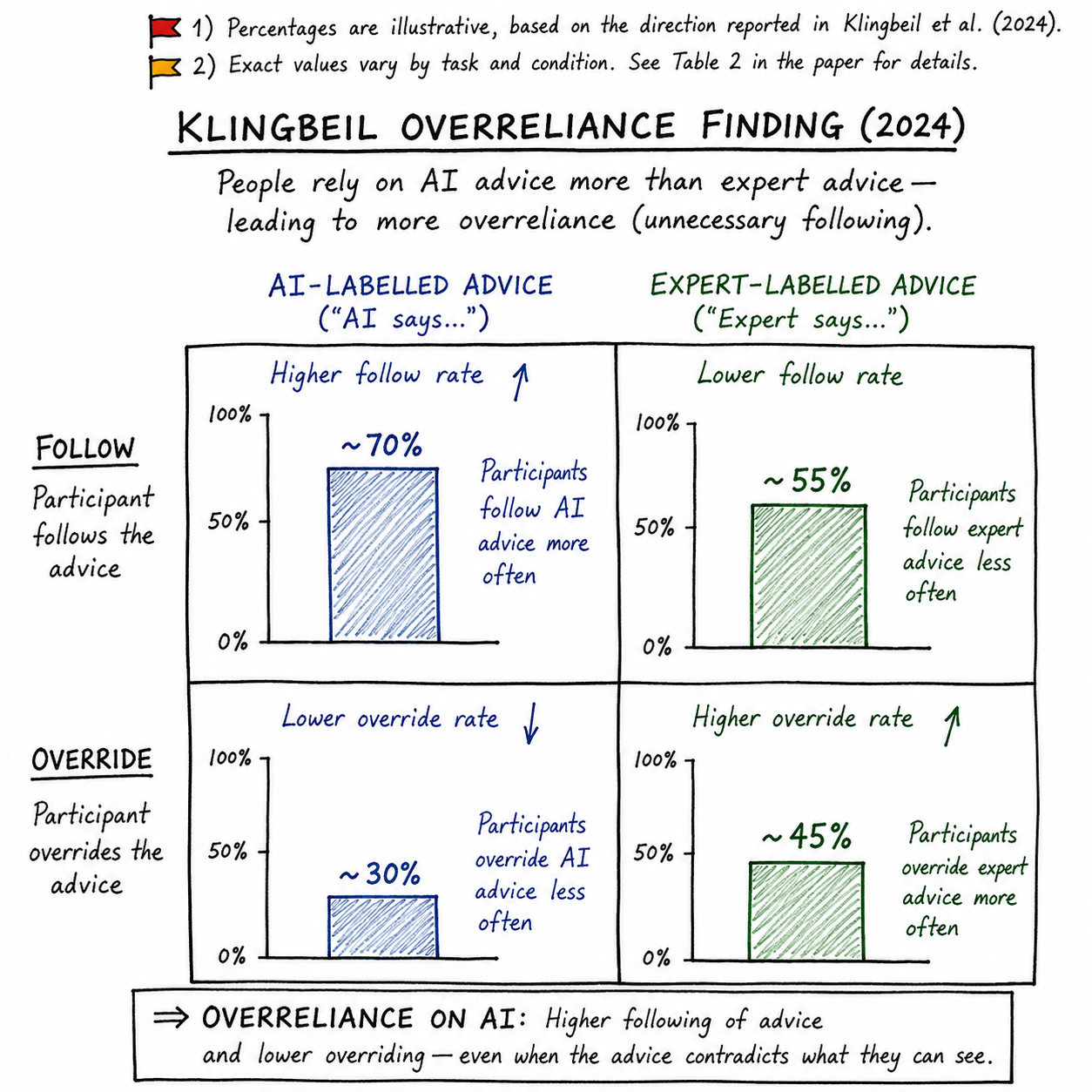
The second paper, from a German team led by Klingbeil and published last year in Computers in Human Behavior, ran a different experiment. Participants played a trust game where they had to decide whether to cooperate with another person. Some received advice. The advice text was identical for everyone, but half were told it came from an AI and half from an expert. Same words. Same context. Different label. The AI label produced significantly higher reliance, including in scenarios where the advice contradicted what participants could see with their own eyes about the other player’s past behaviour. People followed AI advice they had every reason to reject, and they did it more readily than they followed identical advice from a human expert.
The label was enough. That is the finding that should make every business leader sit up.
Why the convergence matters more than either paper alone
The two studies arrive at the same destination from opposite directions. Wharton manipulated whether the AI was right or wrong and measured what people did with the output. Klingbeil held the output constant and manipulated only the perceived source. Different methods, different participants, different countries, different tasks. Same result: the presence of AI causes a measurable drop in the human’s critical engagement with the answer in front of them.
If only Wharton had run the study, you could argue the participants were rationally trusting an authoritative source. If only Klingbeil had run it, you could argue it was a quirk of trust games. Together they close the door on both objections. The phenomenon is real, it is measurable, it generalises across tasks, and the trigger is not the quality of the AI’s reasoning but the label attached to it.
What this actually looks like at work
The Hansen observation that has been circulating on LinkedIn this week, that “we are no longer arguing with people, we are arguing with a chat bot”, is the same finding as the Wharton paper, expressed in plain English. The colleague who defends the LLM’s output against the consultant who has done the work for fifteen years is not having a debate. They are running a relay. You are not engaging their judgment, you are engaging the seed prompt of a system trained on yesterday’s internet and a memory of the last three messages they sent it. And the relay station is significantly more confident than the human ever was, because the AI delivers its output in fluent, structured, authoritative prose that masks the absence of any underlying conviction.
This matters enormously for any business that depends on its people exercising judgment. Hiring decisions, supplier selection, technical specifications, customer escalations, pricing calls. These are precisely the areas where AI is now embedded in the workflow, and they are precisely the areas where cognitive surrender produces the most expensive mistakes. The Klingbeil data is the warning shot: even with the contradicting evidence sitting in front of them, even with money at stake for themselves and a third party, participants followed the AI label.
Why this is not a doom narrative
Here is where I part company with the apocalyptic evangelists. Cognitive surrender is real and the data is unambiguous, but it is not a destination, it is the early phase of a learning curve.
It took nearly a century for seat belts to become mandatory in cars. The first drivers used cars recklessly, the early decades produced casualty rates that look insane by today’s standards, and yet nobody now argues that cars were a mistake. The pattern with every meaningful technology is the same: humans adopt before they learn to use it properly, the J curve dips, and then the compounding benefits arrive once the discipline catches up with the capability.
The Wharton paper itself supports this read. When participants were given financial incentives and immediate feedback on whether they had been right, cognitive surrender did not disappear, but it dropped from 73% to 58% on the wrong-advice trials. The behaviour is malleable. The discipline can be trained. The question is whether your organisation trains it.
What to actually do about it
Three things, none of them clever.
First, never let an AI output stand without articulating why it might be wrong. Out loud, in a comment, in a margin note. The Klingbeil result is clear that the killer is the absence of counterargument, not the presence of bad advice. Most professionals are perfectly capable of spotting flaws in AI output when they are forced to look. They simply do not look, because the output sounds confident and the path of least resistance is to accept it.
Second, treat the AI like a first-of-class graduate who joined this morning. Brilliant, fast, knows nothing about your business, will say the most confident wrong thing you have ever heard with a straight face. Give it context, interrogate its output, do not assume it understands your situation. The mental model “powerful junior” produces better behaviour than the mental model “oracle”.
Third, and this is the one most leaders skip, audit the moments where you agreed with the AI quickly. Those are the moments where the surrender is happening, not the moments where you argued back. Every leader can recall the time the AI was wrong and they caught it. Almost no leader can recall the time the AI was wrong and they did not. That asymmetry is the entire problem.
The choice the data forces
The Wharton paper found that susceptibility to cognitive surrender was strongly predicted by trust in AI and inversely predicted by Need for Cognition and fluid intelligence. The Klingbeil paper found that the people most resistant to surrender were those who actively reasoned about the advice rather than evaluating its source. Neither finding is surprising. Both point to the same conclusion: the inequality that AI will produce in the next decade is not between those who use it and those who don’t, it is between those who engage with it and those who outsource to it.
That choice is available to every professional reading this. It does not require a technical background, an expensive course, or special tools. It requires the discipline of treating every AI output as a draft that needs interrogation rather than a verdict that needs filing.
The technology is not the problem. The posture is.
Sources:
- Shaw, S. D., & Nave, G. (2026). Thinking—Fast, Slow, and Artificial: How AI is Reshaping Human Reasoning and the Rise of Cognitive Surrender. The Wharton School.
- Klingbeil, A., Grützner, C., & Schreck, P. (2024). Trust and reliance on AI — An experimental study on the extent and costs of overreliance on AI. Computers in Human Behavior, 160.
- Budzyń, K. et al. (2025). Endoscopist deskilling risk after exposure to artificial intelligence in colonoscopy. The Lancet Gastroenterology & Hepatology.