
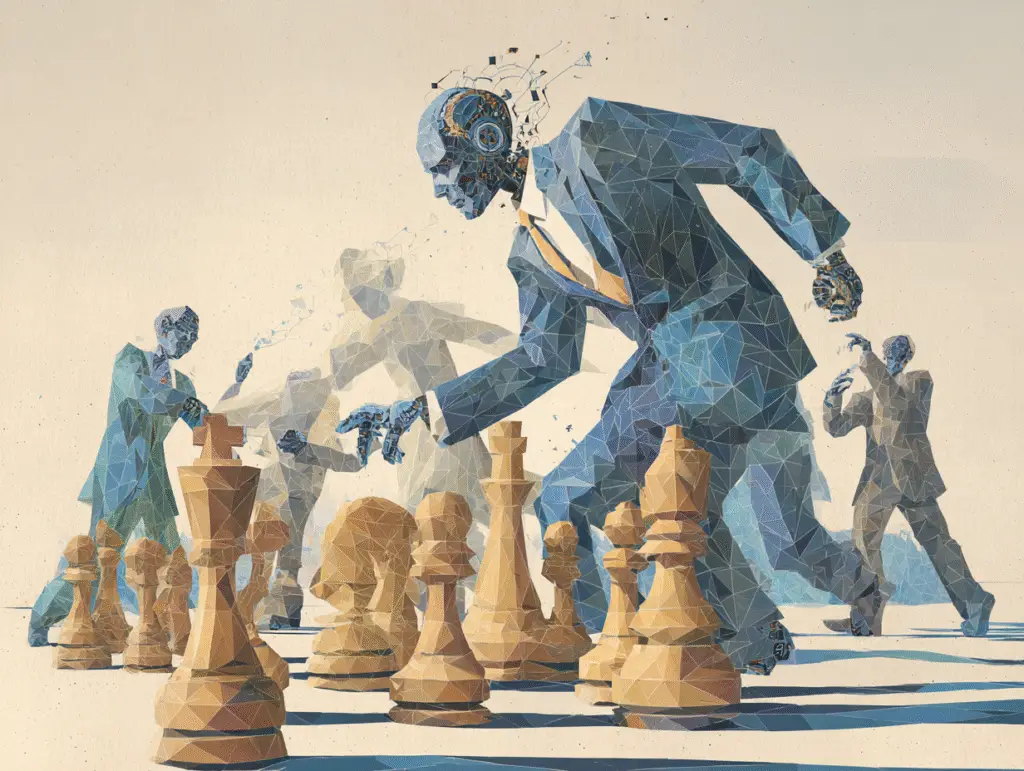
I used to think AI was something only the IT team needed to worry about. That changed the day I realised a competitor was using AI to outmanoeuvre us in customer insights. I felt like a ship captain who just discovered the rival vessel had radar while I was sailing by stars. In recent years, we’ve witnessed AI’s profound impact across virtually all industries – from transforming customer service to revolutionising supply chain management. It’s as if a new engine is powering the business world, one fueled by data and algorithms.
Yet despite AI’s broad reach, many of us in leadership have treated it as “someone else’s problem.” In fact, 40% of employees believe the IT department spearheads AI policy in their organization, while only 23% think business leaders are leading the charge. Ouch. That statistic hit me hard. If I’m at the helm of a company, why would I hand off a game-changing technology to a silo? Given today’s advances, shouldn’t we as business leaders be at the forefront of AI integration? (Spoiler: Yes, we should!)
Stepping Up to the AI Challenge
The truth is, AI is not just another tech tool – it’s a game-changer for business strategy, customer engagement, and efficiency, and over 82% of CEOs say it will significantly impact their business. We leaders already know the stakes. But knowing isn’t enough; we have to act on that knowledge.
I remind myself that effective leadership in the age of AI means weaving AI into core strategic planning and decision-making. This isn’t about micromanaging the nuts and bolts of algorithms; it’s about aligning AI initiatives with our vision and goals. If an AI project doesn’t tie into our strategy or improve the customer experience, why are we doing it? It falls to leadership to ask these questions.
Still, embracing this responsibility can be daunting. I look around and see that truly AI-driven organisations are rare. One survey found that only 1% of leaders would call their companies “AI-mature,” meaning AI is fully integrated into workflows and driving major results. Just 1%! The vast majority of us are still in the early days, experimenting with pilots or piecemeal solutions. That tells me there’s a huge opportunity on the table – and a risk that if we don’t seize it, someone else will.
It’s a bit like the early days of the internet. Decades ago, some executives dismissed the web as an IT project or a fad. Others saw it for what it was: a revolution in how business operates. We know how that story ended. As one analysis put it, the risk for business leaders isn’t thinking too big with AI, but thinking too small. If we underestimate AI’s potential, we might end up like those companies that clung to typewriters while competitors embraced digital.
From Passenger to Pilot
For me, taking responsibility for AI meant shifting my mindset from passive to proactive. I could no longer be a passenger on the AI train – I had to be the conductor. In practice, that meant learning the basics of AI capabilities so I could have meaningful conversations with my tech teams and ask the right questions. It also meant championing AI projects that aligned with our strategic priorities (instead of just approving whatever new tool the IT folks fancied).
I’ve learned that leading on AI is about people as much as technology. If my employees sense I’m on board with AI, they get on board too. When leaders show strong support for AI adoption, the share of employees who feel positive about tools like generative AI jumps from 15% to 55%. That’s a massive cultural shift powered simply by leadership engagement. So I talk about AI in town halls, celebrate team experiments with AI, and address fears openly. Our people need to know AI isn’t here to replace them, but to help them – and we leaders are responsible for conveying that vision.
Allow me to quote something that really drove this home for me. Geoff Woods, author of The AI-Driven Leader, bluntly states that “the difference between growing your business and going out of business is your ability to think strategically. The problem: Leaders are stuck in the operational weeds, while their competition gains an edge with AI. The time to act is now.” I felt that one in my gut. It sums up why every leader must embrace AI. We need to get out of the weeds, leverage AI to free up our time, and focus on strategic moves. Our competitors are already doing it.
Embrace the Responsibility
At the end of the day, being an AI-driven leader is about accountability. If AI is charting the future of business, then guiding AI adoption is part of my job description now. I’m effectively becoming my organisation’s “Chief AI Champion,” making sure we invest in the right AI opportunities, deploy them ethically, and align them with our mission.
This isn’t a responsibility you can delegate. Sure, I lean on data scientists and IT experts for technical execution, but the vision of why and where we apply AI should come from leadership. Whether it’s using AI to personalise customer experiences or optimise supply chains, it has to tie into the big-picture strategy that I help set.
The leaders who get this right will spearhead companies that innovate faster, serve customers better, and operate more efficiently. Those who don’t? They’ll be playing catch-up in a few years, wondering where they went wrong. In my view, every leader has a simple choice: embrace AI’s potential or risk irrelevance. And for anyone still on the fence, remember – the time to act is now. The future won’t wait, and neither will AI.
Harnessing AI for Faster, Smarter Decisions
Figure: Conceptual illustration of a human leader supported by AI intelligence in decision-making.
I had a critical decision to make by morning and was drowning in information. In the past, I’d have pulled an all-nighter with spreadsheets, but this time I let an AI tool do the heavy lifting while I slept. By dawn, it had sifted through all the data and sent me a clear summary of key insights – as if I’d hired an expert working 24/7 at lightning speed. That’s when I realised how transformative AI can be for a leader’s decision-making.
I’m not alone in feeling this overload. Research shows 85% of business leaders have felt “decision stress,” and 75% say the number of decisions they make daily has exploded tenfold in three years. No wonder we feel exhausted. We’re making more decisions faster than ever, often with higher stakes. I asked myself: How can I make smarter choices without burning out my brain or my team? For me, the answer was to embrace AI as a decision-making partner.
AI: My Decision-Making Co-Pilot
AI isn’t a replacement for my intuition or experience – it’s a powerful amplifier of them, racing through oceans of data to help me steer through complexity with clarity and confidence. I think of it as my co-pilot. I’m still in the captain’s seat, but now I have an intelligent assistant scanning the horizon and whispering insights in my ear.
When developing a new product strategy, I used to spend weeks gathering data and combing through reports. Now I can ask an AI to do that grunt work in minutes. It spots patterns and anomalies I might have missed – say, an unexpected surge in customer interest from a new region – and presents them clearly. AI essentially collapses the time it takes to turn raw data into decision-ready insight. What might have taken my team a month of analysis, we can now accomplish in a day or two.
Another big benefit is how AI boosts my team’s productivity. Many rote tasks – compiling numbers, drafting routine reports – can be offloaded to AI, freeing my team to focus on creative problem-solving and strategy. It’s like each person suddenly has a highly efficient assistant. It’s no exaggeration to say this technology can “10x the impact” of each employee. I saw this with my own team: after we used AI to automate our weekly reports, my analysts spent those hours on deeper analysis and fresh ideas instead of tedious data prep.
Making AI Work for You
Getting these benefits required some changes in how we work. One key was choosing the right problems for AI to tackle. It’s tempting to try AI on everything, but I found it better to start with a few high-impact areas. In fact, research by BCG found that top-performing companies focus on a small number of AI use cases – around 3 or 4 – and by doing so, they expect over twice the return (2.1× ROI) on their AI initiatives compared to less focused firms. That inspired me to be selective. We identified two critical processes where AI could truly move the needle and concentrated our efforts there first.
My team also needed support to leverage AI. You can’t just install a tool and expect magic; people have to learn new skills and workflows. Unfortunately, many companies lag on this front – less than one-third have trained even a quarter of their workforce to use AI tools. I was determined not to fall into that trap. We organised training sessions and created internal “AI champions” to help colleagues learn and experiment. The more comfortable my team gets with AI, the more value we extract from it.
Finally, we set clear guidelines for using AI responsibly. In our company, AI can make recommendations, but humans make the final call. By establishing that rule, we maintain accountability and trust. If the AI flags a cost-saving opportunity, we still debate its merits and potential downsides. Everyone understands that AI is there to inform our decisions, not to dictate them.
Earning Trust and Staying Human
My employees have been eager to embrace AI – often more optimistic about it than I expected. Surveys show that about 47% of employees expect to use AI significantly in their jobs soon, whereas only 20% of leaders think that way. That gap reminded me to listen to my team’s ideas on where AI could help, because they’re full of good suggestions.
Employees also need to trust that AI won’t harm them or the business. I’ve read that 71% of employees trust their own company to implement AI ethically and responsibly, far more than they trust third parties. To meet that trust, I make transparency a priority: we explain why and how we’re using AI, address concerns about jobs or data privacy, and involve team members in pilot projects so they feel part of the process.
All these steps – focusing on impact, upskilling the team, setting guardrails, and being transparent – have paid off. Today, our organisation is making decisions faster and more confidently than before. I spend less time buried in reports and more time strategising, because AI handles so much of the heavy lifting. And far from removing the “human touch,” it has amplified it – my team and I have more bandwidth to apply creativity, empathy, and critical thinking where it matters most.
And this trend isn’t just at my company – 92% of executives plan to increase their investment in AI in the near future, as the early hype gives way to practical results and ROI.
For me, harnessing AI has been a game-changer. It’s like I’ve gained an extra brain, giving me insights I might have missed otherwise. I’m still steering the ship, but now I have data-driven winds in my sails. The bottom line: when it comes to making tough calls, AI plus human beats human alone. Using AI as my partner in decision-making hasn’t made leadership any less important – it’s made it more effective.