
There’s a moment I keep coming back to. I was reviewing a backlog of product development tasks, and something didn’t add up. Our customer churn had slowed, but the pipeline wasn’t moving any faster. I fed some structured and unstructured data into an AI tool, layered it with CRM and production schedules, and it flagged a bottleneck that none of us had spotted — not because we weren’t capable, but because we were too close to the problem.
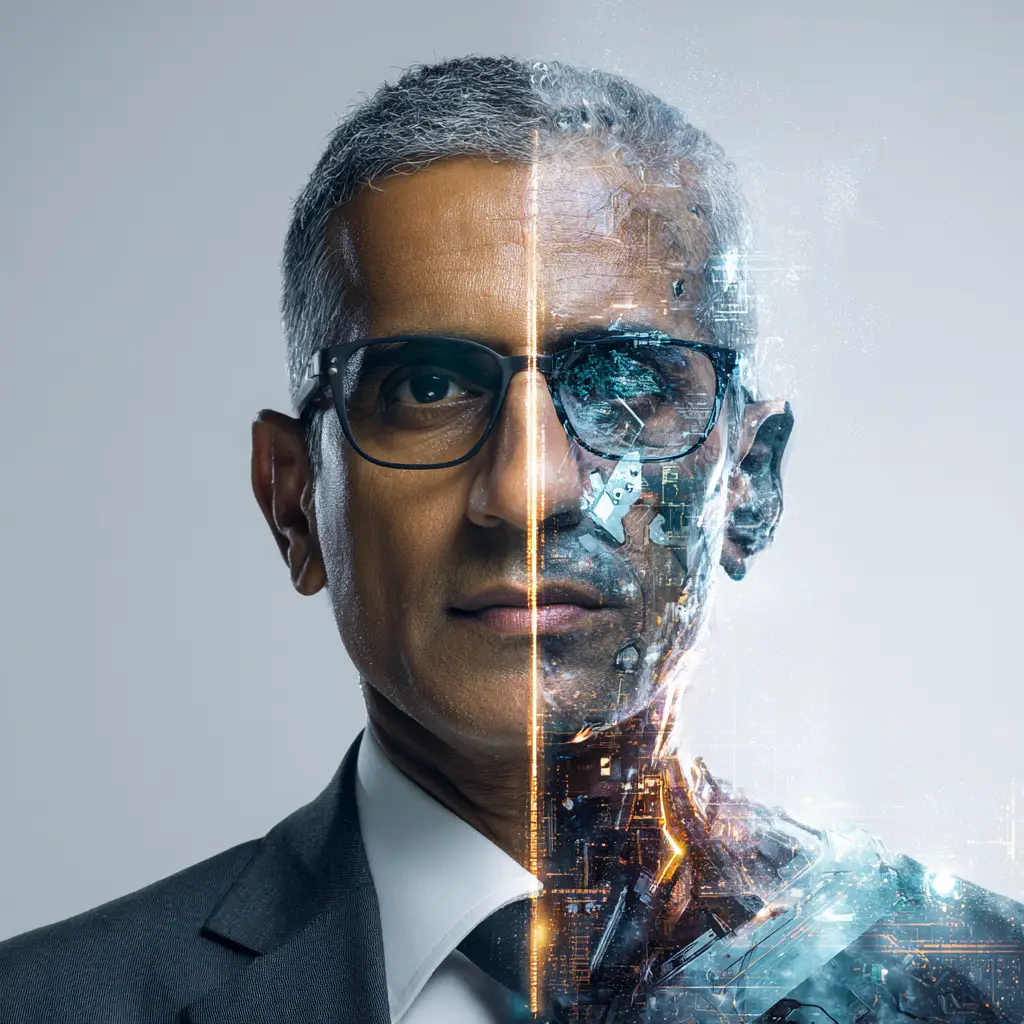
That was the moment I realised something important: AI isn’t replacing me — it’s expanding me. My time, my judgment, my decision-making capacity — all amplified.
Welcome to the era of AI-augmented leadership.
 What Is an AI-Augmented Leader?
We often hear about AI replacing jobs or disrupting functions. But when I talk about AI in my work with engineering firms — from battery manufacturing to instrumentation — I see something else happening. The leaders who thrive aren’t the ones who resist or blindly delegate AI to IT. They’re the ones who actively incorporate AI into how they think, lead, and decide.
AI-augmented leaders aren’t coders. They’re strategic integrators. They know how to ask the right questions, test assumptions, and use AI to challenge their own bias and bandwidth. Korn Ferry calls it a shift toward judgment amplified by data. I call it keeping your edge in a world where instinct alone isn’t enough.

 From Command-and-Control to Curiosity-and-Collaboration
Let me be blunt: the traits that made you successful 10 years ago won’t carry you through the next 10. Not without adaptation.
In my early MD days, authority came from experience, and leadership meant decisiveness and direction. But AI changes that equation. Today, the best leaders aren’t the loudest or the most certain — they’re the most curious, adaptable, and collaborative.
I’ve had to shift from being the one with answers to the one asking better questions:
- What assumptions are we making that AI could test or disprove?
- Where are we spending time manually that could be redirected to thinking?
- What can we automate so we can focus more on insight, not administration?
AI doesn’t eliminate leadership. It raises the bar for it.
 How I’ve Embedded AI into My Leadership
Let me give you something practical. Here’s how I’ve adapted as a leader in AI-forward projects:
1. Product Development
I no longer just rely on engineering instinct or past experience. AI helps us simulate market reactions, compare development paths, and optimise resource use. I still make the call — but it’s a better-informed one.
2. Financial Strategy
Working capital is the lifeblood of any industrial business. I’ve used AI to build smarter cash flow models, test stress scenarios, and reduce forecasting bias. My role? Interpret the output, challenge it, and act on it.
3. Ops & Supply Chain
With AI-backed scheduling and predictive maintenance, we’ve improved throughput and avoided costly downtime. But it’s not plug-and-play. I guide the adoption, align it to strategy, and keep people on board.
4. People & Culture
Yes, even here. We’ve used AI to analyse team collaboration patterns (no surveillance nonsense — just productivity signals). It helped us restructure decision rights, clarify roles, and reduce meeting fatigue.
 Leading With Tech, Without Losing Touch
Here’s the nuance: AI gives you power, but it also requires humility.
The AI-augmented leader doesn’t pretend to know everything. They invite the machine into the conversation. They accept uncertainty, but act decisively with better tools. And most of all, they stay grounded. In human needs, team dynamics and the “why” behind the data.
What we need isn’t techno-worship or fear — it’s pragmatic integration. Especially in engineering-heavy industries where cycles are long, risks are high, and every edge matters.
 A Word of Warning
The biggest trap I see is leaders who think using AI is optional. It’s not. AI is now a table-stakes capability — not because it’s trendy, but because it’s fundamentally changing how competitors move. You might not see it yet, but trust me, it’s already happening.
Your competitors aren’t just adopting AI tools — they’re hiring AI-augmented leaders. People who know how to steer, challenge, and apply what the machines suggest. If you’re not augmenting your leadership, you’re already trailing behind.

 The Real Competitive Edge
AI doesn’t make us less human. It makes us more focused, more strategic, and more scalable. It allows us to delegate repetition so we can lead with precision. That’s what I try to bring to every company I work with — whether it’s through a turnaround, a growth phase, or an AI transformation.
So, if you’re unsure where to start, don’t worry. Most of us didn’t grow up with this stuff. But that’s not an excuse to opt out. It’s a call to step up.
AI won’t replace you.
But a leader who knows how to use AI just might.